
Trew Landscape Blog
Deck Cost per Square Foot: Kansas City 2026 Guide
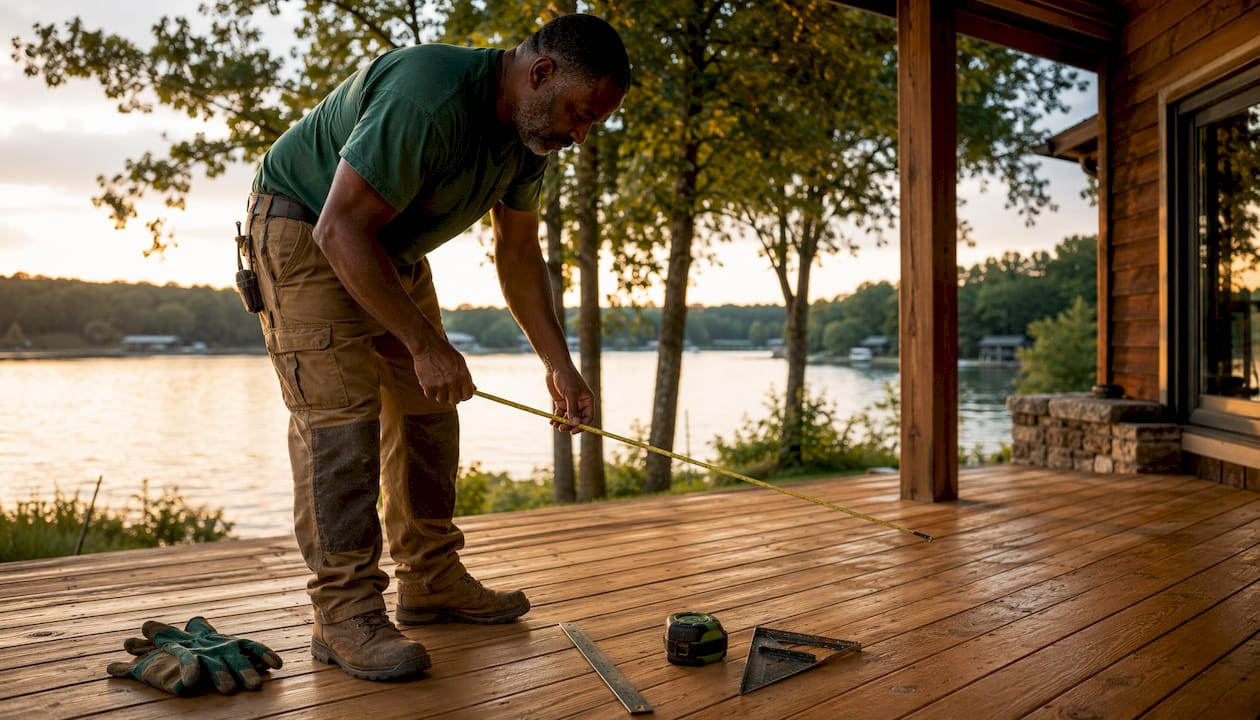
Deck Cost per Square Foot: Kansas City 2026 Guide ! Man measuring wooden deck in Kansas City neighborhood In Kansas City, installed deck cost per square foot runs in a range consistent with pressure-treated wood, composite, and PVC or premium capped composite, based on 2026 regional pricing with the Midwest labor baseline applied.
Deck Cost per Square Foot: Kansas City 2026 Guide
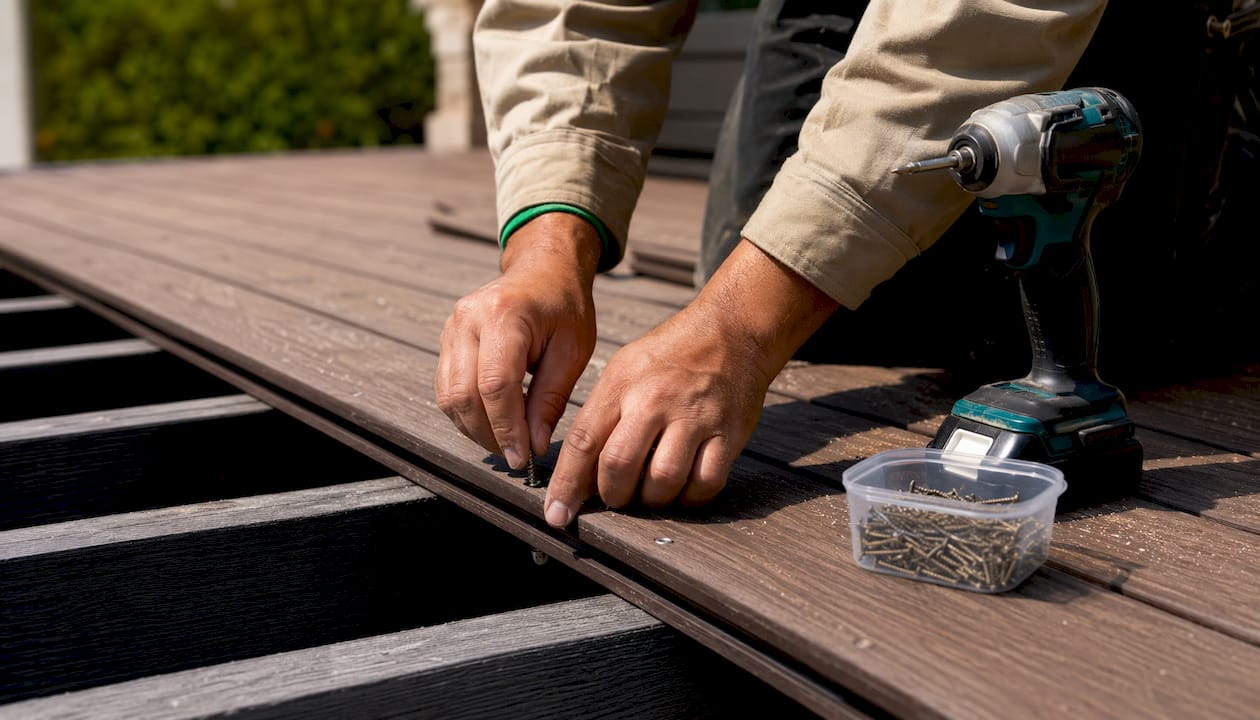
In Kansas City, installed deck cost per square foot runs in a range consistent with pressure-treated wood, composite, and PVC or premium capped composite, based on 2026 regional pricing with the Midwest labor baseline applied. Hardwood options like Ipe push past $90/sq ft installed. Most KC homeowners land in the pressure-treated or mid-range composite tier, balancing upfront budget against the area’s freeze-thaw cycles and humid summers.
Here is how to use these numbers right now:
- Pressure-treated wood is typically the lowest cost installed option, best for budget-focused builds
- Cedar is naturally rot-resistant with no chemical treatment and is considered a solid mid-range choice
- Economy composite offers low maintenance and good durability without the premium price
- Premium/capped composite has a moisture-resistant cap layer, suitable for wet climates
- PVC decking is made with zero wood content and offers maximum moisture resistance
- Tropical hardwoods like Ipe offer exceptional lifespan and premium appearance but come with higher upfront cost
Multiply your planned deck area by the mid-point of your preferred material band to get a working budget. Then get two or three local contractor quotes to pressure-test that number against actual site conditions.
Pro Tip: Add 10–15% to your initial estimate as a contingency buffer before you start talking to contractors. Kansas City’s clay soil regularly surprises homeowners with footing costs that don’t show up in any online calculator.
Table of Contents
- What does deck cost per square foot actually include?
- What changes the price per square foot on your specific project?
- What do add-ons cost on top of the base $/sq ft?
- How do labor and materials split, and when does DIY make sense?
- How to estimate your total deck cost from $/sq ft
- Kansas City-specific factors that affect your deck budget
- Trewlandscape builds decks in Kansas City with no guesswork on cost
- Key Takeaways
- Why hiring a local KC contractor is almost always worth it
What does deck cost per square foot actually include?
The installed price per square foot is not just boards and nails. It covers decking material, framing lumber, fasteners, footings, labor, and a basic railing allowance. Understanding what drives each piece helps you read a contractor bid without getting lost.
| Material | Installed $/sq ft (low–high) | Material-only $/sq ft | Typical labor $/sq ft | Lifespan / Maintenance | Best for |
|---|---|---|---|---|---|
| Pressure-treated wood | $25–$40 | $2–$5 | $8–$18 | 15–25 yrs / annual staining | Budget builds |
| Cedar | $35–$50 | $3–$6 | $10–$20 | 20–30 yrs / biennial sealing | Mid-range, natural look |
| Economy composite | $40–$55 | $12–$20 | $10–$18 | 25–30 yrs / occasional cleaning | Low-maintenance families |
| Premium/capped composite | $55–$95 | $20–$40 | $12–$20 | 30+ yrs / minimal cleaning | Low-maintenance premium |
| PVC | $65–$90 | $25–$45 | $14–$22 | 30+ yrs / rinse only | Maximum moisture resistance |
| Ipe (tropical hardwood) | $90–$100 | $10–$20 | $18–$30 | 40–75 yrs / annual oiling | Premium, long-term investment |
One detail most homeowners miss: the substructure (joists, beams, posts) is almost always pressure-treated lumber regardless of what you choose for the deck boards. So the material cost difference between a PT deck and a composite deck is mainly in the boards, railing system, and hidden fasteners — not the bones underneath.
25-year total cost of ownership (TCO) perspective:
- Pressure-treated wood requires yearly or biennial staining at roughly $0.30–$0.55/sq ft per year. Over 25 years on a 300 sq ft deck, that adds $2,250–$4,125 in maintenance alone, before any board replacement.
- Economy composite runs about $0.04–$0.06/sq ft per year in cleaning costs — roughly $300–$450 over the same 25-year window.
- Premium capped composite and PVC sit in a similar low-maintenance range, with the added benefit of a manufacturer warranty that typically covers fading and staining.
- Ipe’s 40–75-year lifespan means you may never replace the boards, but annual oiling is non-negotiable to prevent cracking in KC’s dry winters.
The math is clear: pressure-treated wood wins on day one, but composite often wins on 25-year cost once you factor in maintenance and replacement reserves. For most Kansas City homeowners who plan to stay in their home a decade or more, mid-range composite is the smarter financial choice.
What changes the price per square foot on your specific project?
The bands above assume a straightforward, single-level deck with standard access. Real projects rarely match that description. Here are the variables that move the number most.
- Deck size: Larger decks cost less per square foot because fixed costs (mobilization, setup, permit fees) spread across more area. A 100 sq ft deck often runs $5–$10/sq ft more than a 400 sq ft deck in the same material.
- Shape complexity: A simple rectangle is the baseline. An L-shape adds roughly 10% to the per-square-foot cost; a multi-tier or wraparound design can add 15–25% above the base rate.
- Height and elevation: Raised decks over three feet require additional posts, deeper footings, and code-required railings. Budget an extra 15–25% on the base installed price for anything elevated.
- Number of stairs: Each stair run is typically quoted separately (see add-ons below) and adds meaningful cost to the total.
- Railing type: A basic pressure-treated railing is the cheapest option. Cable railing, aluminum balusters, or glass panels can cost three to four times as much per linear foot.
- Site access: A backyard with a narrow gate or a steep slope costs more to work in. Contractors factor in equipment access and material staging time.
- Soil and footings: Kansas City’s heavy clay soil often requires larger concrete footings or deeper excavation. This is one of the most common sources of cost overruns on KC projects.
- Demolition: Tearing out an existing deck adds $500–$2,000 depending on size and material, and is almost always quoted as a separate line item.
- Local labor: Kansas City sits at the Midwest baseline multiplier of 1.00, meaning installed prices here track closely with national averages — unlike the Northeast (1.22x) or West Coast (1.28x).
Pro Tip: Budget a 10–15% contingency on top of your contractor quote, not just your estimate. Unexpected footing depth, buried concrete, or drainage issues are common discoveries once excavation starts in KC’s clay-heavy yards.
What do add-ons cost on top of the base $/sq ft?
The per-square-foot rate covers the deck platform. Most projects need several extras that are quoted separately, and these can add 20–40% to the base platform cost on a typical KC build.
| Add-on | Typical cost range | Notes |
|---|---|---|
| Pressure-treated railing | $32–$55 per linear foot | Most common, lowest cost |
| Composite railing | $55–$70 per linear foot | Matches composite deck boards |
| Cable railing | $80–$100 per linear foot | Premium look, requires steel posts |
| Stairs (per step) | $150–$350 per step | Material-dependent; varies widely |
| Concrete footings | $50–$120 per footing | KC clay often requires deeper pours |
| Deck lighting (low-voltage) | $200–$450 per project | Post cap lights, step lights, string |
| Built-in bench | $150–$300 per linear foot | Framed and finished |
| Pergola (attached) | $3,000–$9,000 | Size and material dependent |
| Demolition of existing deck | $500–$2,000 | Quoted separately by most contractors |
A few things worth knowing about how contractors handle these line items. Railings and stairs are almost always quoted separately from the deck platform, even when the $/sq ft headline number looks all-inclusive. Always ask your contractor to break out railing linear footage, stair count, and footing quantity as separate line items. That is the only way to compare bids apples-to-apples.
Lighting is often the last thing homeowners budget for and the first thing they wish they had planned from the start. Running conduit during framing costs a fraction of what it costs to add it after the deck is built. If landscape lighting is on your wish list, mention it before the framing crew shows up.
For concrete footing work specifically, Kansas City projects frequently run above national averages because of the clay soil’s tendency to shift. A contractor who evaluates your site before quoting footings is worth more than one who uses a flat per-footing number without looking.
How do labor and materials split, and when does DIY make sense?
Labor typically accounts for 45–55% of total installed cost on a mid-range deck. On a $15,000 composite project, that means roughly $6,750–$8,250 in labor and overhead, with the rest in materials. Nationally, contractor labor runs $8–$20/sq ft depending on complexity and material; composite installation takes longer than pressure-treated, which pushes labor cost up even when material prices are similar.
The Midwest baseline multiplier of 1.00 means Kansas City labor rates track the national average closely. You are not paying the Northeast premium, but you are also not getting the South’s discount (0.92x). For a 280 sq ft deck, expect $2,240–$5,600 in labor alone before materials, add-ons, or permits.
Reasons to hire a professional:
- Any deck attached to the house via a ledger board (ledger failure is a leading cause of deck collapses)
- Elevated decks over 30 inches that require engineered footings and code-compliant railings
- Projects requiring a building permit and structural plan review
- Complex railing systems (cable, glass, aluminum) with specific torque and post-spacing requirements
- Sites with drainage issues, significant slope, or clay soil conditions requiring deeper footings
- Any project where a warranty on workmanship matters to you
When DIY is realistic:
- A simple, freestanding ground-level platform under 200 sq ft with no ledger attachment
- Pressure-treated framing and decking with standard post-cap railings
- A homeowner with prior framing experience and access to proper tools
- A project in a jurisdiction where a permit is not required for small freestanding structures (verify with your local municipality first)
The honest math on DIY: materials typically run 40–50% of the installed price, so a $12,000 professionally installed PT deck might cost $5,000–$6,000 in materials if you supply the labor. That is real money. But for anything attached to your house or elevated, the DIY vs. professional tradeoffs tip heavily toward hiring a pro once you factor in permit liability, structural risk, and the time investment.
How to estimate your total deck cost from $/sq ft
Getting from a per-square-foot number to a realistic project budget takes four steps. Work through them before you call a contractor and you will have a quote-ready number to anchor the conversation.
- Measure your footprint. Length × width gives you square footage. Do not include stairs or landings in this number — they are quoted separately.
- Choose your material band. Pick the installed $/sq ft range that matches your material preference and multiply by your square footage. Use the mid-point of the range for a planning number.
- Apply complexity multipliers. Single-level rectangle = 1.00x. L-shape = 1.10x. Multi-tier = 1.20x. Raised over 3 ft = add 15–25% to the base.
- Add line items. Railings (linear footage × $/LF), stairs (step count × $/step), footings, lighting, demolition, and permit fees. Then add 10–15% contingency.
Example 1: 14×20 composite deck (280 sq ft)
- Base: 280 sq ft × $65/sq ft (mid-range composite) = $18,200
- Complexity: single level, standard access = 1.00x
- Railings: 48 LF × $70/LF = $3,360
- Stairs: 1 run × 4 steps × $250/step = $1,000
- Permit: $400 (estimated KC range)
- Contingency (12%): $2,712
- Estimated total: ~$25,672
Example 2: 10×10 pressure-treated deck (100 sq ft)
- Base: 100 sq ft × $32/sq ft (mid-range PT) = $3,200
- Complexity: ground-level, simple = 1.00x
- Railings: 30 LF × $45/LF = $1,350
- No stairs (ground-level)
- Permit: $200
- Contingency (12%): $570
- Estimated total: ~$5,320
Checklist of line items to request on every contractor bid:
- Decking material species/brand and board thickness
- Framing lumber grade and spacing
- Hidden fastener system (or exposed screw pattern)
- Railing linear footage and material spec
- Stair count and material
- Footing diameter, depth, and concrete volume
- Permit fee (included or billed separately)
- Demolition of existing structure (if applicable)
- Warranty terms on labor and materials
Kansas City-specific factors that affect your deck budget
Kansas City sits at the Midwest labor baseline, so your installed $/sq ft will track national averages more closely than projects in coastal markets. That is the good news. The local variables that can push costs above those averages are mostly underground.
- Heavy clay soil: KC’s clay-heavy soil expands and contracts significantly with moisture changes. Footings for attached or elevated decks often need to go deeper than the national standard to reach stable bearing soil, and land grading or drainage work may be needed before framing begins.
- Drainage: Poor drainage under a deck accelerates wood decay and can undermine footings over time. Sites with standing water or poor slope away from the house may need drain tile installation as part of the project scope.
- Permit fees and timelines: Kansas City area permit fees typically fall in the $200–$1,500 range depending on project size and whether a structural plan is required. Attached or elevated decks almost always trigger a plan review, which can add several weeks to your project start date.
- Seasonal pricing: Spring and early summer are peak demand for deck contractors in KC. Booking in late winter (January–February) or scheduling a fall build (September–October) can improve contractor availability and sometimes pricing. Summer backlogs are real — a contractor who can start in June may not be available until August.
- Weather and material choice: KC’s freeze-thaw cycles and humid summers are hard on untreated wood. Composite and PVC materials hold up better through the seasonal swings, which is one reason premium composite has gained ground in this market over the past several years.
- Sustainable and local materials: Cedar sourced from North American suppliers is widely available through KC-area lumber yards and carries no chemical treatment concerns. For homeowners prioritizing sustainability, it is the most accessible locally-sourced option at a reasonable price point.
Pro Tip: Ask your contractor specifically whether their footing quote assumes standard depth or site-evaluated depth. In Kansas City, a flat per-footing price without a site visit is a red flag — clay soil conditions vary block to block.
How these $/sq ft ranges were derived
The cost bands in this article blend 2026 national pricing data from industry calculators with regional labor multipliers and contractor benchmark data. Here is the methodology in brief:
- Primary banding sources: PaperPlan’s 2026 deck cost guide and DeckMath’s 2026 deck building cost guide provided the core installed $/sq ft tiers by material.
- Regional adjustment: The Midwest labor multiplier of 1.00 (baseline) was applied to the labor portion of each band. No upward or downward adjustment was made for Kansas City specifically, as KC tracks the Midwest average.
- Add-on costs: Per-linear-foot railing costs and per-step stair costs come from national contractor benchmark data cross-referenced with PaperPlan’s 2026 figures.
- Labor split: The 45–55% labor share of installed cost comes from DeckMath’s cost-per-square-foot calculator data.
- Pricing snapshot: All figures reflect 2026 pricing as published by the sources listed. Material prices, particularly lumber, can shift with supply chain conditions — verify current material costs with your supplier or contractor before finalizing a budget.
To update these ranges for your own project, run your exact dimensions through a national calculator like DeckMath or PaperPlan, apply the Midwest multiplier (1.00) to the labor line, then add KC-specific line items (deeper footings, permit fees, drainage) as needed.
- Ranges are planning estimates, not contractor quotes
- Site conditions, material availability, and contractor overhead vary
- Always get at least two local bids before committing to a budget
A note on national vs. local data: National calculators are a reliable starting point for Kansas City because the Midwest multiplier is 1.00. The main gaps they miss are KC-specific soil conditions and local permit timelines — which is why a site visit from a local contractor remains the most accurate pricing tool available.
Trewlandscape builds decks in Kansas City with no guesswork on cost
Budgeting a deck is one thing. Getting it built right in Kansas City’s clay soil, through the permit process, and finished before the summer entertaining season is another.
Trewlandscape handles deck installation across the Kansas City area, along with the site work that deck projects here almost always need: land grading, concrete footings, drain tile for drainage issues, and hardscape design if you want to integrate a patio or outdoor kitchen alongside the deck. Every estimate includes a site evaluation that accounts for your specific soil conditions and drainage, so the footing line item in your quote reflects your actual yard, not a national average. Permits, structural requirements, and material specs are handled transparently, with line-item breakdowns so you know exactly what you are paying for. Request a free estimate and Trewlandscape can run the calculation method from this article against your exact deck footprint, giving you a KC-specific number before any work begins.
Key Takeaways
Installed deck cost in Kansas City runs $25–$40/sq ft for pressure-treated wood and $55–$95/sq ft for premium composite, with labor accounting for roughly 45–55% of the total and KC’s clay soil regularly adding to footing costs above national estimates.
| Point | Details |
|---|---|
| Installed cost bands | Pressure-treated: $25–$40/sq ft; economy composite: $40–$55/sq ft; premium/capped composite: $55–$95/sq ft; PVC: $65–$90/sq ft installed. |
| Labor share | Labor typically runs 45–55% of total installed cost; KC tracks the Midwest baseline (1.00x multiplier). |
| Biggest cost drivers | Deck size, height/elevation (+15–25%), shape complexity, railing type, and KC clay soil footings move the price most. |
| 25-year TCO | Composite maintenance costs roughly $0.04–$0.06/sq ft/year vs. $0.30–$0.55/sq ft/year for pressure-treated wood. |
| Trewlandscape | Provides site-evaluated estimates, permit handling, and full deck installation in Kansas City with transparent line-item pricing. |
Why hiring a local KC contractor is almost always worth it
The case for DIY on a deck sounds compelling until you price out the permit, the footing excavation, and the ledger attachment hardware. For a simple, freestanding ground-level platform under 200 sq ft with no attachment to the house, a confident homeowner with framing experience can save real money. That is the honest ceiling of where DIY makes sense.
Everything else tilts toward a professional, and in Kansas City, the reasons are more specific than the generic “hire a pro” advice you will find anywhere. The clay soil here does not behave like the sandy loam that most national deck guides assume. Footings that would be adequate in a drier climate can heave or settle in KC’s freeze-thaw cycles, and a ledger board attached to a rim joist without proper flashing is a moisture problem waiting to happen in this climate. These are not hypothetical risks — they are the most common sources of deck failures and insurance disputes in the region.
Code compliance is the other factor that homeowners consistently underestimate. An attached or elevated deck in Kansas City requires a permit, a structural plan in many cases, and an inspection before the decking boards go down. A contractor who pulls permits and schedules inspections as part of their standard process is not charging you extra for bureaucracy — they are protecting your home’s resale value and your liability exposure. A deck built without a permit is a problem you will discover at the worst possible time: when you try to sell the house.
The practical argument for Trewlandscape specifically is the combination of deck installation with the site work that KC projects need. Grading, drainage, and concrete footings handled by the same crew that builds the deck means one point of accountability and no finger-pointing between subcontractors when a drainage issue shows up after the build.
Useful sources and further reading
These are the primary sources used to build the cost ranges and methodology in this article. Each one offers a calculator or detailed breakdown you can use to refine numbers for your specific project.
- PaperPlan — Cost to Build a Deck (2026): National installed cost bands by material, size, and features with permit cost ranges. Good starting point for total project budgeting.
- DeckMath — Deck Building Cost Guide 2026: Per-material $/sq ft tiers, regional labor multipliers by market, and 25-year TCO comparisons. The most detailed regional breakdown available.
- DeckMath — Cost Per Square Foot Calculator: Interactive calculator; enter your dimensions, material, and features to get an installed range with labor split.
- EstimationPro — Deck Cost Guide: National labor rate ranges and project examples useful for checking contractor bids.
- Angi — How Much Does It Cost to Build a Deck?: Consumer-facing cost data and contractor recommendations; useful for understanding what local homeowners are actually paying.
- TrueSealCoating — Residential Sealing: For homeowners choosing pressure-treated or cedar, sealing and surface protection options that affect long-term maintenance costs.
| Source | Best used for |
|---|---|
| PaperPlan | Total project budgeting with permit line items |
| DeckMath Cost Guide | Regional multipliers and TCO comparisons |
| DeckMath Calculator | Interactive per-sq-ft estimate by material |
| EstimationPro | Labor rate benchmarking |
| Angi | Real homeowner cost data and local contractor context |